
Buying Guides
Nachi and EZO Bearings: Bearing Numbers, Sizes and Fitting Guide
When a motor starts to growl or a pump runs hot, the bearings are usually the first suspect, and usually the cheapest fix. We sell two Japanese brands of deep-groove ball bearing: Nachi and EZO. Both are made to the same international dimension standard as every other major brand, so a 6203 is a 6203 whoever made it.
The two suit different jobs. Nachi 2NSE9CM bearings have rubber seals on both sides and a clearance made for electric motors, which makes them the dependable choice for motor, pump and gearbox repairs, especially where dust or damp gets in. EZO P6 C3 bearings are precision miniature bearings with extra internal clearance, built for small motors, fans, power tools and spindles that run fast and warm. Whichever suits the job, the replacement needs the same number as the one stamped on the old bearing, such as 6203 or 608.
This guide covers how to read a bearing number, what “2NSE9CM” and “P6 C3” mean, which brand fits which job, and how to get an old bearing out and a new one in without damaging either.
Do Nachi and EZO fit where other brands came out?
Yes. Bore, outside diameter and width follow ISO 15, so sizes are interchangeable across makers. Some bearings in each range are made outside Japan to the same specifications. Where the better brands earn their price is consistency: rounder rings, smoother raceways and clearance held to spec. You notice it as a quieter, cooler motor that goes longer between rebuilds.
How to read a bearing number
The number on a deep-groove ball bearing tells you its size and type. Take 6203-2NSE9CM:
- 6 – the bearing type. 6 is a single-row deep-groove ball bearing.
- 2 – the series, meaning how big and strong the bearing is for its bore. 0 is extra light, 2 is light and 3 is medium. A 6303 has the same 17 mm bore as a 6203 but is larger and takes more load.
- 03 – the bore code. 00 = 10 mm, 01 = 12 mm, 02 = 15 mm and 03 = 17 mm. From 04 up, multiply by 5: 04 = 20 mm, 05 = 25 mm, 10 = 50 mm.
- Letters after the number – seals, shields and clearance. 2RS or 2NSE means rubber seals on both sides, ZZ means metal shields on both sides, C3 means more internal clearance than standard, and CM is a clearance made for electric motors.
Miniature bearings have three digits, and the last digit is the bore in millimetres: a 608 has an 8 mm bore and a 626 has a 6 mm bore.
6202 vs 6203 vs 6205
These are all light-series (62) bearings. They differ only in size, so they are not interchangeable:
| Bearing | Bore | Outside diameter | Width |
|---|---|---|---|
| 6202 | 15 mm | 35 mm | 11 mm |
| 6203 | 17 mm | 40 mm | 12 mm |
| 6205 | 25 mm | 52 mm | 15 mm |
Common motor bearing sizes
Bore × outside diameter × width, in millimetres. The column headings link to each range.
| Bore | 6000 series (extra light) | 6200 series (light) | 6300 series (medium) |
|---|---|---|---|
| 10 mm | 6000 · 10×26×8 | 6200 · 10×30×9 | 6300 · 10×35×11 |
| 12 mm | 6001 · 12×28×8 | 6201 · 12×32×10 | 6301 · 12×37×12 |
| 15 mm | 6002 · 15×32×9 | 6202 · 15×35×11 | 6302 · 15×42×13 |
| 17 mm | 6003 · 17×35×10 | 6203 · 17×40×12 | 6303 · 17×47×14 |
| 20 mm | 6004 · 20×42×12 | 6204 · 20×47×14 | 6304 · 20×52×15 |
| 25 mm | 6005 · 25×47×12 | 6205 · 25×52×15 | 6305 · 25×62×17 |
We stock these Nachi ranges up to a 50 mm bore (60 mm in the 6300 series), the 6200 series with metal shields (ZZECM), and EZO miniature bearings in the 600 series (604 to 609) and 620 series (623 to 629).
Finding the bearing number on your motor
- Look at the old bearing. The number, such as 6203-2RS, is stamped or printed on the seal or shield face, or on the outer ring, usually with the maker’s name.
- Check the motor’s nameplate or manual. Many list the drive-end (DE) and non-drive-end (NDE) bearings. The two ends are often different sizes, so check both.
- Measure it if the number has worn off. Clean the bearing and measure the bore, outside diameter and width in millimetres with vernier callipers, then find the match in the size table above.
- Note the letters as well as the numbers. Seals (2RS) or shields (ZZ), and the clearance (C3, CM), matter as much as the size. Replace like with like unless you are upgrading on purpose.
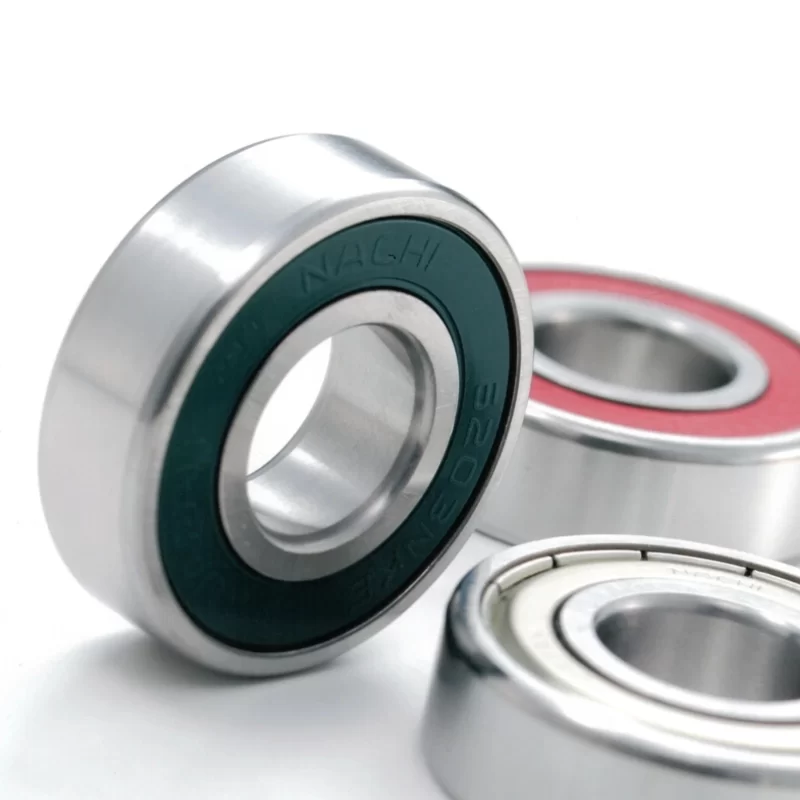
Nachi 2NSE9CM Bearings
Nachi-Fujikoshi is a Japanese maker of bearings, machine tools and robots. Its deep-groove ball bearings turn up in cars and in general industrial equipment.
What the letters in 2NSE9CM mean:
- 2NSE – Nachi’s contact rubber seals on both sides (other brands write 2RS). They keep the grease in and dust and water out.
- CM – a radial internal clearance made for electric motors. It sits between standard and C3 clearance, so the bearing runs quietly while leaving room for the shaft to warm up and expand.
They’re sealed for life, so there’s nothing to re-grease, and the seals make them the safer pick for motors and pumps in dusty or damp places.
Typical applications: electric motor shafts, gearboxes, pumps, farm machinery, conveyor rollers and automotive accessory drives.
Browse our full range of Nachi 2NSE9CM bearings in the 6000, 6200 and 6300 series. For higher speeds in clean conditions, the Nachi ZZECM range has metal shields instead of rubber seals. Seals are the better choice where dust or water can get in.

EZO P6 C3 Precision Deep-Groove Ball Bearings
EZO is the bearing brand of Sapporo Precision Inc., a Japanese maker of high-precision miniature bearings for machine tools, robots and instruments.
P6 C3 is two separate specifications:
- P6 – a JIS/ISO precision tolerance class, one step above standard (P0). The rings are rounder and run truer, so there’s less vibration at speed. P6 is roughly ABEC-3.
- C3 – more internal clearance than standard (CN/C0). As the bearing warms up and expands, the extra room stops the balls binding against the races.
So: tighter tolerances for less vibration, and extra clearance for bearings that run warm.
Typical applications: small electric motors, spindles, small pumps, fans, power tools and robotics.
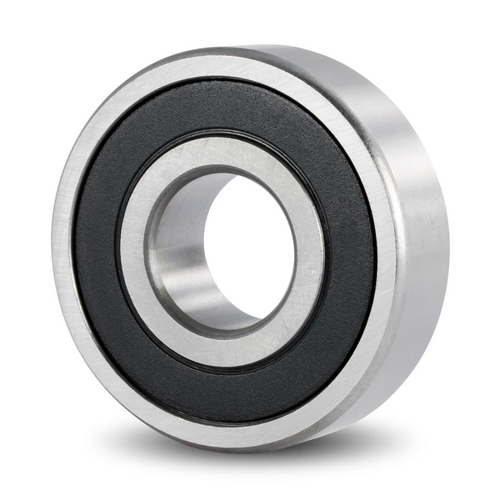
Shop our EZO P6 C3 precision bearings in the 600 and 620 miniature series, all rubber sealed on both sides (2RS).
Nachi or EZO?
Usually the shaft decides. Our EZO bearings are miniatures, 3 to 9 mm bore, the sort found in fans, power tools and small motors. Our Nachi bearings start at 10 mm. So you’re rarely choosing between them for the same job.
What you do choose is the letters after the number. Nachi comes with rubber seals (2NSE) for dusty or wet places, or with metal shields (ZZECM, 6200 series) for cleaner, faster-running gear. The EZO miniatures we stock are all rubber sealed (2RS) with C3 clearance.
| Nachi 2NSE9CM | EZO P6 C3 | |
|---|---|---|
| Bore sizes we stock | 10 to 50 mm (60 mm in the 6300 series) | 3 to 9 mm (miniature) |
| Best suited to | General industrial motors, pumps, dusty/wet environments | Small motors, fans, power tools, spindles |
| Seal type | Rubber seals on both sides (2NSE), or metal shields (ZZ) in the 6200 ZZECM range | Rubber seals on both sides (2RS) |
| Internal clearance | CM (electric motor clearance) | C3 (extra clearance for thermal expansion) |
Installing and Removing Bearings in Motors and Appliances
Plenty of motors, pumps and appliances get thrown out over a worn bearing that costs far less to replace. These steps work for washing machine motors, power tools, fan motors and most general-purpose electric motors. Check the service manual first, though: shaft fits and retaining methods vary.
Removing a Bearing
1. Identify the fit type before you start. Most motor-shaft bearings are an interference (press) fit on the inner race and a slip or light press fit on the outer race in the housing. Pulling on the wrong race, or pulling through the balls, will damage the bearing and can scar the shaft. Always plan to apply force through the race that was pressed on.
2. Support the housing or shaft properly. Never rest the assembly on the bearing itself while pressing. Use blocks or a bearing separator plate to support the surrounding component so force only acts on the bearing.
3. Use a bearing puller for shaft-mounted bearings. A two or three-jaw puller (or a blind-bearing puller for bearings seated inside a blind bore) is the standard tool. The jaws grip behind the inner race while the puller’s centre screw draws the bearing straight off the shaft.
4. Use a slide hammer or soft drift for housing-mounted bearings. For bearings pressed into a housing bore (common in pump end-bells and gearbox housings), a slide hammer with internal or external jaws, or a soft punch tapped evenly around the outer race, will walk the bearing out without cocking it in the bore.
5. Seized? Warm the housing, not the bearing. A little heat from a heat gun on the housing around the bearing, never on the seals, expands the housing enough to free a stuck outer race.
Installing a Bearing
1. Check the replacement matches the original. Bore, outside diameter, width and seal type, plus any clearance class the motor’s maker specified (such as C3). The wrong clearance can mean early failure or too much play.
2. Never press force through the balls. Force through the wrong race goes through the balls and dents the raceways (brinelling). You often won’t hear it until weeks later, when the bearing starts to fail.
- When pressing the bearing onto a shaft, apply pressure only to the inner race.
- When pressing the bearing into a housing, apply pressure only to the outer race.
- If a bearing must be seated against both shaft and housing shoulders simultaneously, use a bearing driver set with a sleeve sized to contact both races evenly.
3. If it’s tight, heat the bearing, don’t hammer it. An induction heater expands the inner ring enough to slide it onto the shaft by hand. Sealed bearings like these are packed with grease, so keep them to about 80°C and don’t put them in an oil bath.
4. Let it cool before you run it. After heat-fitting, let the bearing cool and seat fully against its shoulder before you put the motor back together. The clearances settle slightly as everything comes back to room temperature.
5. Check the seals. Make sure the seals on a sealed bearing like the Nachi 2NSE9CM weren’t nicked or pushed in during fitting. If you’re fitting an open bearing instead, pack it with the right grease before assembly, but don’t overfill it: too much grease runs hot.
Buying Nachi and EZO bearings in Australia
Electrowind Sales has supplied motor parts from Wantirna in Melbourne since 2013. We stock genuine Nachi 2NSE9CM and ZZECM bearings in the 6000, 6200 and 6300 series, and EZO P6 C3 precision miniature bearings, and ship them Australia-wide.
Browse all Nachi bearings, EZO precision bearings or deep-groove ball bearings, or contact us if you need help matching a bearing.
Frequently asked questions
What is the difference between 6202, 6203 and 6205 bearings?
Only the size. All three are light-series deep-groove ball bearings: a 6202 is 15×35×11 mm, a 6203 is 17×40×12 mm and a 6205 is 25×52×15 mm (bore × outside diameter × width). They are not interchangeable.
What do 2RS, ZZ and C3 mean on a bearing?
2RS means rubber seals on both sides, which keep grease in and dust and water out. ZZ means metal shields on both sides, which suit higher speeds and cleaner places. C3 is an internal clearance looser than standard, which leaves room for the bearing to expand as it warms up. Nachi’s 2NSE is its version of a rubber seal on both sides.
Can I use a C3 bearing in an electric motor?
Often, yes. Motor bearings warm up in use, so many motor makers specify C3 or a motor clearance such as CM. The safest choice is to match what was fitted originally or what the motor’s maker specifies.
Can I replace a bearing with a different brand?
Yes, as long as the number, the seal or shield type and the clearance match. Nachi and EZO bearings are made to the same international dimension standard (ISO 15) as other major brands, so a 6203 from one maker fits where a 6203 from another came out.
Where can I buy Nachi bearings in Australia?
Electrowind Sales stocks genuine Nachi bearings in the 6000, 6200 and 6300 series, and EZO precision miniature bearings, and ships Australia-wide from Melbourne. See our Nachi bearings range.
